Wu Hung Three Gorges Damn and Contemporary Chinese Art
| Dong | |
|---|---|
 | |
| Directed past | Jia Zhangke |
| Produced by | Yu Lik-wai Zhu Jiong Chow Keung Dan Bo |
| Starring | Liu Xiaodong |
| Cinematography | Yu Lik-wai Jia Zhangke Grub ChiSang Tian Li |
| Edited past | Kong Jinglei Zhang Jia |
| Music by | Lim Giong |
| Distributed by | Xstream Pictures |
| Release dates |
|
| Running time | 66 minutes |
| Countries | China Hong Kong |
| Languages | Mandarin Sichuanese Thai |
Dong (simplified Chinese: 东; traditional Chinese: 東; pinyin: dōng ; lit. 'East') is a 2006 documentary film past Chinese director, Jia Zhangke. The moving-picture show follows the artist and actor Liu Xiaodong equally he invites Jia to film him while he paints a group of labourers virtually the Three Gorges Dam (too the discipline of Jia's pic Nonetheless Life) and later a group of women in Bangkok.[1] The film was produced and distributed by Jia'south own production company, Xstream Pictures, based out of Hong Kong and Beijing.[two]
Dong was screened at the 2006 63rd Venice International Movie Festival as part of its "Horizons" Plan, and as role of the 2006 Toronto International Flick Festival'southward "Real-to-Reel" Plan. It was filmed in HD digital video.[3]
Groundwork [edit]
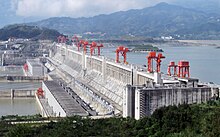
3 Gorges Region [edit]
The Three Gorges region forth the Yangtze River in Fengjie is located in Chongqing, the South-East section of China, it is an old town with a history of more than than 2000 years.[4] The 3 Gorges Dam beingness constructed in this region is known as the world's largest hydropower project and a symbol of "Chinese modernity", aiming to better navigation and also produce electricity.[1]
This project was started since 1990s in order to solve free energy bug and the h2o level was required to raise 10 meters high.[v] It causes flooding of towns and villages around the place, with a huge loss of residential areas and cultural heritages, and millions of native residents were and then forced to readapt to new places.[i] Fengjie as one of the towns firstly being submerged by the water storage organisation of the power generation project, was relocated to a higher altitude in 2002.[four]
Liu Xiaodong [edit]
Liu Xiaodong is a contemporary Chinese artist built-in in 1963 in Liaoning Province, Mainland china. He is a friend of Dong's director Jia Zhangke and is also influential on the rise of China'south 6th generation filmmakers.[half-dozen] Liu was known as a "documentary painter" since he has collaborated with many Chinese filmmakers and produced more than than 20 films around the world to document his progress of paintings.[vii]
He mainly focuses his artwork on the living states of workers and labours from the lower class in the society through his portrayal of natural beauty while travelling. His conception to reveal the developing economy in People's republic of china was explored in his paintings as he moved intimately towards the world, illustrating ordinary people from both urban and rural areas in his motherland.[vii]

Hot Bed [edit]
Hot Bed is one of Liu Xiaodong'south painting project composed of two parts during his four weeks journeying in Fengjie China and Bangkook Thailand. The whole painting is near ten meters long. In this artwork, Liu demonstrates his objective painting method through portraying the meaningless moment of life to enhance the visual objectivity rather than focusing on the visual perfection.[8]
The first part is an artwork that portrays 11 construction workers working in Fengjie city who were demolishing their own homes in the summertime of 2005 after the construction of the hydro-electric ability station, and so migrating to other cities afterwards.[9]
In the 2d office, 12 female sex workers wearing colourful dress were chosen by Liu in Bangkok. He bundled his models side by side to fruits and sofa, illustrating a painting with drowsy women under sunshine with tropical fruits.[x]
The vivid mattress links two artworks equally a medium of temporary remainder. It looks like a river flowing underneath two places to protect people. In Liu's view, it is a warm bed that people could stay to escape before long from reality.[ten]
Synopsis [edit]
The documentary is separated into two sections:
The get-go part took identify in the Three Gorges Region in China in 2005, recording downwards the working process of painter Liu Xiaodong with his painting project 'Hot Bed' that portrays the dam workers in the region who were experiencing migration due to the construction of 3 Gorges dam.[11] Eleven local workers were his models for the painting while he visited Fengjie during the construction of the project, and they were playing cards and resting in swimming trunks before their homes being deconstructed.[12]
The second office then follows Liu'due south journey in Bangkok, Thailand in 2006 where he invited 11 female sex workers being his models for another painting. The tropical and drowsy atmosphere of the city was portrayed under his sketch of women and fruits.[i] He also draws down 2 blind men who were walking through the crowded market.[13]
Rivers in both cities demonstrate their attitudes of lives moving frontward without returning.[1]
Several interviews are conducted in both sections to share Liu'due south formulation and credo in his artwork, demonstrating his connexion with the world.[13]
Central Theme [edit]
Issues in Communist china [edit]
Class [edit]
Dong equally a realistic documentary, reveals how the resilience of people living in poverty is able to help them suffer their struggling lives. The daily reality of depression-class people in gimmicky Chinese society has been illustrated through Jia's ability to tell ordinary stories in an empathetic style.[14] Both director Jia and the painter Liu concerned with mod realistic social situations through their vision of art and culture and aiming to portray them in their painting and filming.[1]
Geographical Construction Impacts [edit]
The living circumstances of people impacted by the hydropower project along the Yangtze River of Iii Gorges Region were reflected, which many towns are flooded, and residents were forced to leave their homes and migrant to completely new places.[15] Information technology reveals the effect of economical development in Communist china has fatigued on local residents from lower form, which China'due south fast-paced development and construction has resulted in issues affected local residents.[1]
Fusion Cinema [edit]
Dong equally a hybrid genre documentary emphasises Jia's conception of fusion movie theater. People would look at his characters subjectively through each different view of the world rather than just accepting truth from it. The appearance of fictional scenes within Dong shows how Jia departs from audiences' expectation of traditional documentaries, questioning film genres as a class of label.[thirteen]
Realism [edit]
Jia mentions in his interview with Variety that documentary is about helping people to "sympathize and remember what we've lived through".[16]
Jia was frustrated past the limitation of realism when he was filming Dong and he sees realism as an expanding concept, a way of thinking rather than simply a style.[17] He inserted fictional elements within the picture show and explains that surrealism should besides be added to show a more realistic perspective on the fastness of China's development and transformation.[18]
Relationship with Still Life [edit]
The fictional film Still Life besides directed by Jia Zhangke has two parallel storylines of a coal worker and a nurse who came to Fengjie from Shanxi (where Jia was born) to find their spouses who left them years ago. It creates Jia'south connectedness as an outsider with Fengjie, since he relates himself into the place and local people through this picture.[xix] It won the 2006 Golden Lion at the 63rd Venice International Flick Festival.[20]
Filmed at the aforementioned time every bit Jia's fiction moving picture, Still Life, Dong too shares the aforementioned setting (the Three Gorges area of central Communist china) and in certain instances, the same shots. This causes them to make a closely linked relationship with each other.[1] Jia mentions once in his interview that he has always been trying to "knock downward the bulwark betwixt documentary and fiction".[21] He portrays the documentary with a more subjective view and reflects the realistic perspective in the fictional pic Still Life, overstepping the boundaries betwixt fiction and non-fiction films.[xix]
Han San Ming [edit]
Han Sanming, one of the leads in Still Life, as well appears (in graphic symbol) within Dong as do other characters from that film.[nineteen] He is a key connection between two films. The difference is that Han was presented with a more realistic view in the documentary Dong as a model of Liu Xiaodong's artwork but a more than subjective protagonist in the fictional film All the same Life, the diverse perspectives of this grapheme reveals the complication of Jia's cinema. Information technology allows audiences to expect closely at the human relationship of his work betwixt realism and fiction.[i] Jia further explains that both him and Liu Xiaodong cherish those workers beingness models of their artwork, and he decided to cast Han in his fictional film after seeing him being portrayed on Liu's canvas.[22]
Dong generated less publicity, prompting one critic to deride it as a "pocket-size add-on" to Jia Zhangke'south canon.[23] In comparing, Still Life has achieved more stunning feedback due to more than of the director'south connection with the pic.[24]
Production [edit]

Backside the Scene [edit]
In Fengjie [edit]
Jia Zhangke was invited by his friend, painter Liu Xiaodong at first to visit the Three Gorges Region located in S-eastward of China together, planning to moving picture a documentary for the progress of his new painting serial that mainly focuses on the demolition workers in that surface area and so towards Bangkok to paint female person bar workers.[1]
After their arrival, Jia decided to film another fictional movie besides due to his stupor of the poverty circumstances in the area, and this conclusion during their journeying and then successfully form 2 films in parallels, the documentary Dong and the fictional moving picture Even so Life.[25]
Jia wrote the script for Even so Life in iii days in his hotel, and cast his cousin Han Sanming as a coal miner.[26]
One of Liu's worker model accidentally died during the procedure of filming, Liu and Jia then visited this worker's family, gave photographs and gifts to his children.[13]
Two films shared some similar footage and also the same protagonist under Jia's exploration of the setting Mainland china Fengjie.[17]
In Bangkok [edit]

Random street food view in Bangkok, Thailand.
When they were in Bangkok, one of Liu's model's home was flooded then she returned to her hometown to expect upward her family.[xiii]
During the filming process, Jia received a call from his sister, telling him that their father has been diagnosed of late-stage lung cancer. He went back to China and stayed in the hospital with his father for weeks until his begetter passed away in March 2006.[26]
Picture show Name [edit]
Liu'due south start name Xiaodong in Chinese means 'Fiddling due east' and director thus chose the proper noun 'Dong' (pronunciation of 'East' in Chinese) for the film as this is a documentary of him. It too implies to the geographical location of the setting, which both the Three Gorges Region and Bangkok were located in the Eastward-side of China and Thailand respectively. Moreover, Communist china and Thailand were located in the East side of the world.[13]
Release [edit]
Dong was firstly released on the 63rd Venice International Moving-picture show Festival on 5 September 2006 and was nominated in the 'Horizons' Programme.
It was and then being screened on the 31st Toronto International Film Festival in Canada in 2006 with the 'Real to Reel' Program.[12]
Awards [edit]
| Yr | Award | Category | Result |
|---|---|---|---|
| 2006 | 63rd Venice International Moving-picture show Festival[27] | Horizons Section All-time Documentary | Nominated |
| Horizons Section Open up Prize | Awarded | ||
| 2006 | 31st Toronto International Film Festival[12] | Reel-to-Reel Program | Selected |
Reception [edit]
[edit]
"Dong exemplifies the cinematic mastery that has earned Jia the distinction of being the planet'south most excitingly original filmmaker." (Scott Foundas, LA Weekly)[28]
"Dong and Still Life demonstrates the new and extremely subjective filmmaking style that Jia has pioneered throughout his career." (Shelly Kracier)[19]
"Produced equally a companion piece to Still Life, Dong stands on its own every bit an aesthetically provocative exploration of the documentary course. Blest with the director's signature compositional beauty and humanism, Jia's vision of China is physical and explosive." (Jean-Pierre Rehm, Cahiers du Cinema)[28]
Encounter likewise [edit]
- Still Life - A companion fictional piece directed past Jia Zhangke
- Three Gorges Dam - The setting of Dong in China
- Liu Xiaodong - A Chinese artist, the chief protagonist of Dong
References [edit]
- ^ a b c d due east f yard h i j Bordeleau, Erik (2012). "Jia Zhangke'south Still Life: Devastation as Intersection" (PDF). Scapegoat: Compages/Mural/Political Economy: 26–29.
- ^ "Dong". IFFR. 2015-09-04. Retrieved 2020-05-29 .
- ^ "Pic description". Toronto International Movie Festival. Archived from the original on 2007-10-28. Retrieved 2007-xi-28 .
- ^ a b "Become a shut look at the globe's largest hydropower project - Xinhua | English.news.cn". www.xinhuanet.com . Retrieved 2020-05-29 .
- ^ Watts, Jonathan (2011-05-xix). "China warns of 'urgent bug' facing Three Gorges dam". The Guardian. ISSN 0261-3077. Retrieved 2020-05-29 .
- ^ Li, Jie (2009). "Home and Nation Amid the Rubble: Fei Mu's "Bound in a Small Boondocks" and Jia Zhangke's "Nonetheless Life"". Modern Chinese Literature and Culture. 21–2 (2): 86–125. JSTOR 41491010.
- ^ a b "Liu Xiaodong: an interview with China'due south great documentary painter". www.theartnewspaper.com . Retrieved 2020-05-29 .
- ^ "Hotbed - Liu Xiaodong Solo Exhition | commodity | ARTLINKART | Chinese contemporary art database". world wide web.artlinkart.com . Retrieved 2020-05-28 .
- ^ olga (2014-10-21). ""Hotbed" past Liu Xiaodong". Aesthetic Experience & Global Competence . Retrieved 2020-05-29 .
- ^ a b Shi, Yutong (2019). "Cinematic painting: time in Liu Xiaodong'southward Hotbed No.1 and Three Gorges Dam". Re:Search. 6–1: 60–86. hdl:2142/103721.
- ^ "Memento Films International | Dong". international.memento-films.com . Retrieved 2020-05-29 .
- ^ a b c "Icarus Films: Dong". icarusfilms.com . Retrieved 2020-05-28 .
- ^ a b c d e f Taylor, Kate E. (2011). "Fusion Picture palace: The Relationship Between Jia Zhangke's Films Dong and Still Life". Dekalog 4: On East Asian Filmmakers. U.k.: Wallflower Press. pp. 45–61. ISBN978-1-906660-31-4.
- ^ Szeto, Kin-Yan (2009). "A Moist Middle: Love, Politics and China's Neoliberal Transition in the Films of Jia Zhangke". Visual Anthropology. 22 (2–3): 95–107. doi:x.1080/08949460802623515. S2CID 143761620.
- ^ "notcoming.com | Dong". world wide web.notcoming.com . Retrieved 2020-05-29 .
- ^ Davis, Rebecca (2020-02-24). "Berlin: Red china'due south Jia Zhangke 'Swims' Back to Documentary Shores". Diverseness . Retrieved 2020-05-29 .
- ^ a b ""We should think of realism as an expanding concept." A chat with Jia Zhangke. — Photogénie". Cinea (in Dutch). 2019-03-06. Retrieved 2020-05-29 .
- ^ Byrnes, Corey (2012). "Specters of Realism and the Painter's Gaze in Jia Zhangke's "All the same Life"". Modern Chinese Literature and Culture. 24–two (two): 52–93. JSTOR 42940559.
- ^ a b c d Kraicer, Shelly. "Prc's Wasteland: Jia Zhangke's Withal Life". Cinema Scope, volume 29. Archived from the original on 2008-05-12. Retrieved 2007-11-27 .
- ^ "Still Life: Venice Review". The Hollywood Reporter . Retrieved 2020-05-29 .
- ^ Davis, Rebecca (2020-02-24). "Berlin: China's Jia Zhangke 'Swims' Dorsum to Documentary Shores". Variety . Retrieved 2020-05-28 .
- ^ ""We should call back of realism equally an expanding concept." A chat with Jia Zhangke. — Photogénie". Cinea (in Dutch). 2019-03-06. Retrieved 2020-05-28 .
- ^ Weissberg, Jay (2006-09-18). "Dong". Diversity . Retrieved 2007-11-28 .
- ^ "Still, Life: Looking at Jia Zhang-ke'due south Recent Masterpiece". Brilliant Lights Film Journal. 2007-eleven-02. Retrieved 2020-05-29 .
- ^ Veg, Sebastian (2007-09-fifteen). "From Documentary to Fiction and Back: Reality and Contingency in Wang Bing'due south and Jia Zhangke's films". China Perspectives. 2007 (3). doi:ten.4000/chinaperspectives.2223. ISSN 2070-3449.
- ^ a b Osnos, Evan. "The Long Shot". The New Yorker . Retrieved 2020-05-28 .
- ^ Zhang, Zhen; Zito, Angela (2015). DV-Fabricated China: Digital Subjects and Social Transformations after Independent Pic. U.s.: University of Hawaii Press. p. 353. ISBN978-0-8248-4681-seven.
- ^ a b "Dong". SFMOMA . Retrieved 2020-05-29 .
External links [edit]
- Dong at IMDb
- Dong at AllMovie
- Dong at Rotten Tomatoes
Source: https://en.wikipedia.org/wiki/Dong_(film)
0 Response to "Wu Hung Three Gorges Damn and Contemporary Chinese Art"
Post a Comment